STEB: A Speech-to-Speech Translation Expressiveness Benchmark for Evaluating Beyond Translation Fidelity

Abstract

Speech-to-speech translation (S2ST) should preserve not only lexical meaning, but also expressive attributes: emotion, scenario style, and nonverbal vocalizations (NVs). We introduce STEB (Speech-to-Speech Translation Expressiveness Benchmark), a 32.6-hour Chinese–English benchmark that evaluates both standard dimensions (translation fidelity, speaker similarity, duration alignment) and expressiveness dimensions (emotion, scenario style, NV preservation). For expressiveness evaluation, STEB uses a caption-then-summarize framework that converts speech into structured expressive attributes and compares source and hypothesis attributes with an LLM judge. Human validation shows statistically significant correlations with listener judgments across all expressive dimensions. We evaluate six S2ST systems and find that current systems achieve strong translation fidelity but still struggle with emotion preservation (best: 3.82/5) and NV preservation (best: 2.31/5), identifying expressiveness preservation as an open challenge for S2ST.

Overview

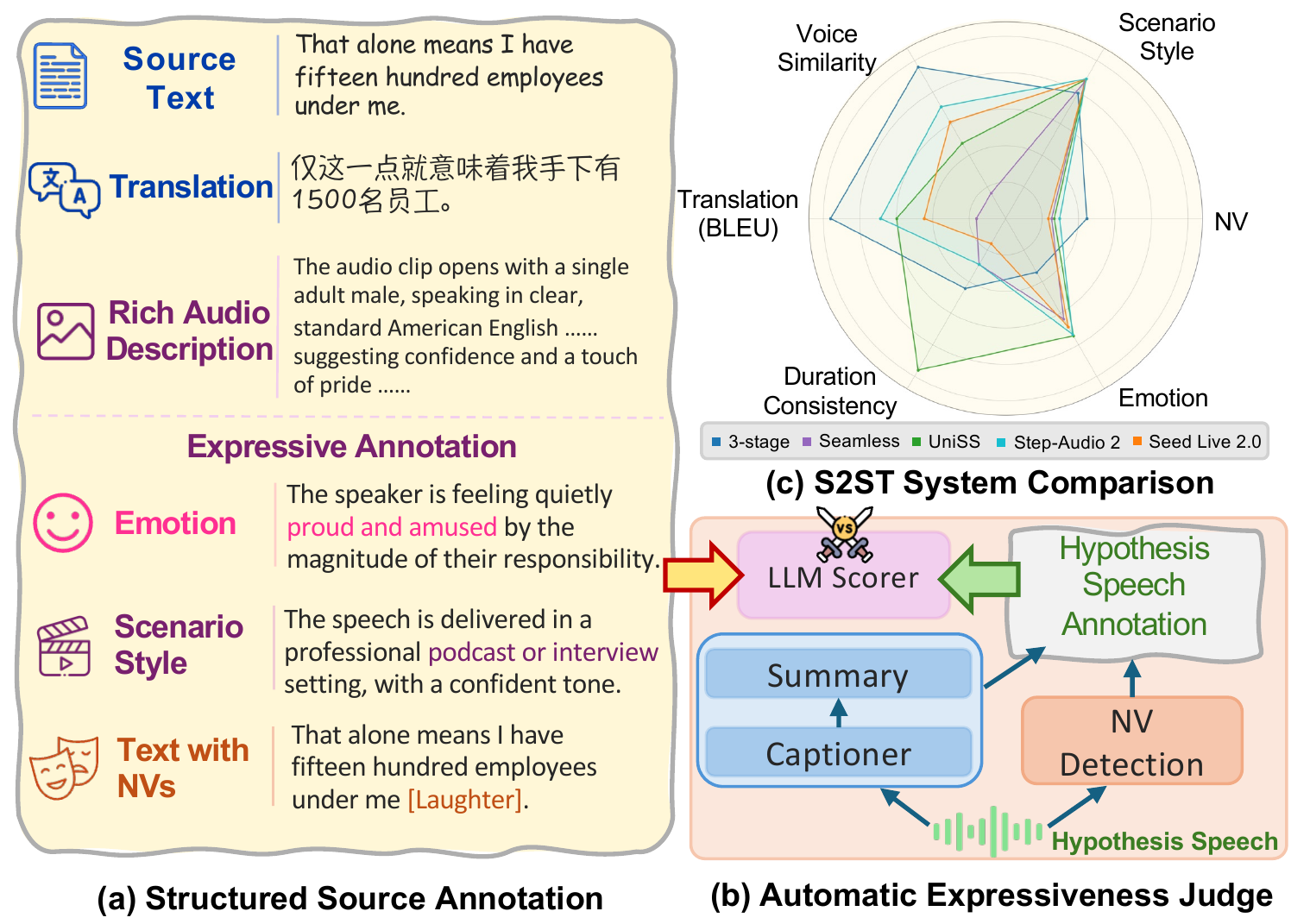
STEB Overview: (a) Benchmark annotation dimensions, (b) Automatic expressiveness judge pipeline, (c) Radar chart comparing S2ST systems
Figure 1. Overview of STEB. (a) Benchmark example showing annotation dimensions: transcription, translation, rich audio description, emotion, scenario style, and text with NVs. (b) The automatic expressiveness judge: a Captioner–Summary pipeline and NV detection extract hypothesis annotations, which an LLM Scorer compares against source annotations. (c) Radar chart comparing baseline systems across six dimensions.

Key Findings

1

Translation ≠ Expressiveness

Most systems achieve strong translation fidelity, but expressiveness preservation lags far behind. Cascaded systems score 1.67–1.73 on emotion (out of 5), while end-to-end models reach up to 3.82.

2

NV Needs Explicit Modeling

Nonverbal vocalizations benefit from explicit text-level markers. Systems with NV detection reach 2.31/5, while end-to-end systems score no higher than 1.58/5.

3

Duration Requires Control

Only systems with dedicated duration control achieve strong alignment (SLC0.2 = 0.98). All other systems remain below 0.66, critical for video dubbing.

Contributions

Data Curation Pipeline

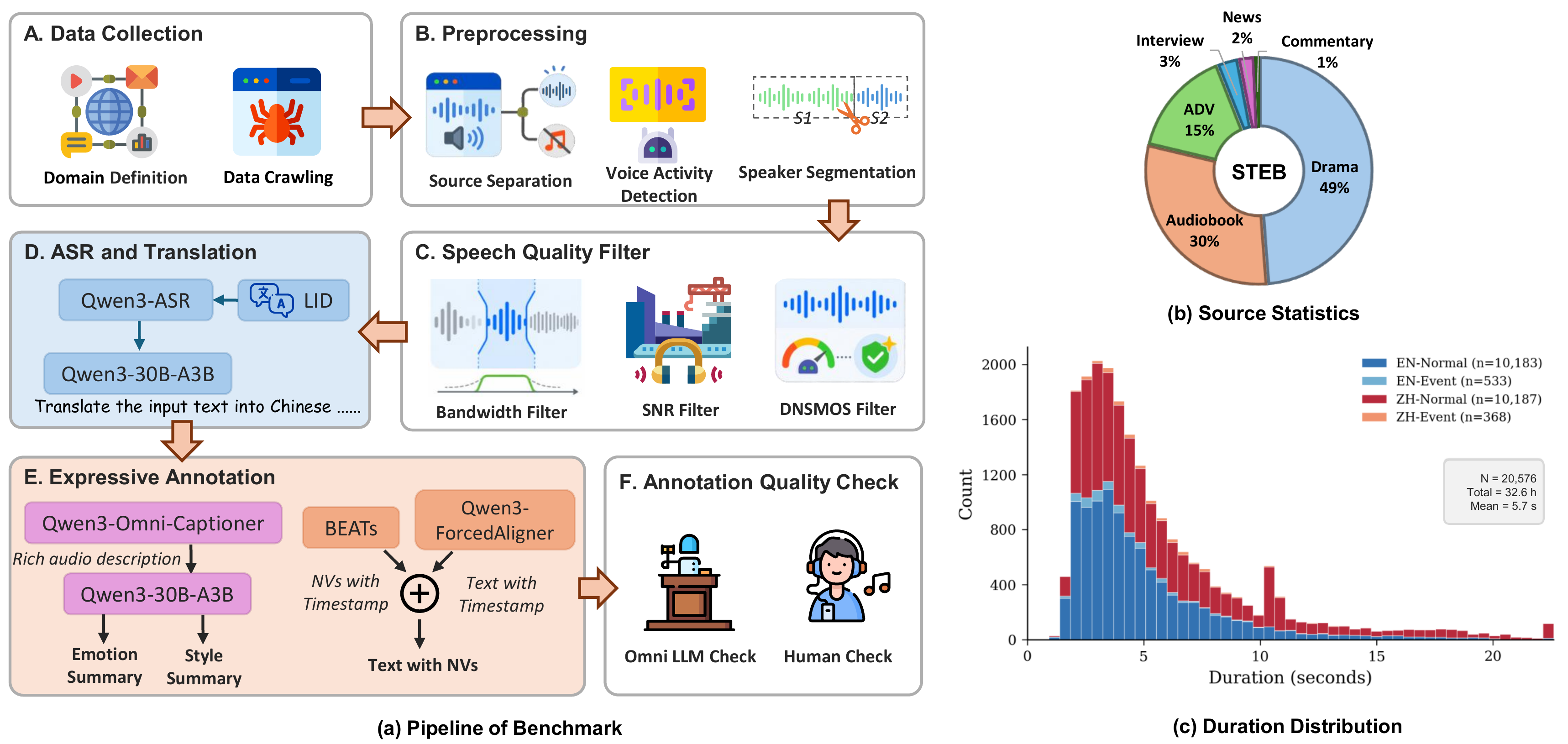
STEB data curation pipeline showing data collection, preprocessing, quality filtering, ASR/translation, expressive annotation, and quality check stages
Figure 2. Data curation pipeline of STEB. The pipeline processes raw web audio through six stages: data collection from diverse scenarios, preprocessing with speaker segmentation, speech quality filtering, ASR and translation, expressive annotation extraction, and annotation quality verification.

Audio Demos

Below are audio samples comparing source speech and translated outputs from different S2ST systems evaluated on STEB.

Benchmark Source Audio

Source samples from the benchmark with human-readable expressive annotations.

Normal Source Samples: ZH

Normal ZH #1

Source Audio
Transcription要有坚定的信念,矢志不移,最后也是最重要的就是凡事要讲求公正,有职,有权的人就更得如此。
TranslationOne must have firm beliefs and remain steadfast. Above all, fairness must be pursued in everything, especially for those in positions of power and authority.
EmotionThe speaker is conveying a sense of calm, unwavering conviction.
Scenario StyleThe speech is delivered in a formal, educational setting, resembling a public service announcement or institutional training module.
Caption
Show caption

The audio clip opens abruptly, immediately presenting a clear, close-mic’d female voice without any background noise or prelude. The speaker, a native Mandarin speaker with a standard Putonghua accent and a mature, educated tone, delivers her message in a calm, authoritative manner. She articulates each syllable with precision, employing a neutral, didactic cadence that is both measured and deliberate. The content of her speech is a moral exhortation: she states, “要有坚定的信念,矢志不移。最后也是最重要的,就是凡事要讲求公正。有职有权的人就更得如此。” (“One must have a firm belief, unwavering. Finally, and most importantly, everything should be done with fairness and justice. Those who have positions of power and authority must be even more so.”) Her speech is free of filler or hesitation, and she maintains a steady, emotionally neutral delivery throughout.

The recording environment is acoustically dry and controlled, suggesting a professional studio or voice booth. There is no reverberation, hiss, or extraneous sound, and the signal is free from technical artifacts. The voice’s clarity and presence are enhanced by subtle, non-intrusive post-production techniques, such as mild compression and EQ, which ensure consistent loudness and brightness. The speaker’s articulation is exceptionally crisp, and the overall timbre is smooth and polished, with a mid-to-high frequency emphasis.

Culturally and contextually, the speaker’s language, accent, and delivery style align with formal Chinese educational or governmental settings. The subject matter—emphasizing steadfast belief, fairness, and the ethical responsibilities of those in power—suggests a didactic or motivational purpose, likely intended for students, officials, or the public in a formal setting. The absence of audience sounds and the professional audio quality further support the impression of a studio recording, possibly for educational broadcasts, public service announcements, or institutional training.

In summary, the audio is a pristine, professionally produced Mandarin-language monologue from a mature female speaker. She imparts a moral message rooted in Confucian and socialist values, urging steadfastness and fairness—particularly among those in power—within a controlled studio environment. The clip’s clarity, tone, and delivery indicate its use in formal, educational, or governmental contexts, intended to inspire ethical conduct and public service.

Normal ZH #2

Source Audio
Transcription那我们前面呢也说了,就是说呃微生物的这个和细胞学的这个发展呢和产生呢都离不开一个重要的一个呃。
TranslationAs we mentioned earlier, the development and emergence of microorganisms and cell biology have always been inseparable from an important factor.
EmotionThe speaker is conveying a calm and composed demeanor, focused on clarity and precision.
Scenario StyleThe speech is delivered in a formal academic lecture setting, typical of a university classroom or scholarly presentation.
Caption
Show caption

The audio clip begins in the midst of a lecture, with a mature male speaker—likely aged 50–70, speaking in standard Putonghua Mandarin—delivering a formal, academic explanation. He references a previous discussion, stating, “那我们前面呢也说了,就是说,呃,微生物的这个和细胞学的这个发展呢和产生呢,都离不开一个重要的一个,呃,” (“So as we mentioned earlier, that is to say, uh, the development and emergence of microbiology and cell biology both cannot be separated from an important, uh...”). The speech is characterized by a slow, measured pace, clear enunciation, and the use of the filler “呃” (“uh”) at several points. The speaker’s tone is calm and didactic, typical of a senior educator or scholar addressing students or peers in a formal setting.

The recording features a low-level, consistent electronic hiss, characteristic of consumer-grade equipment, and a faint 60 Hz hum, indicating electrical interference from the recording environment. The speaker’s voice is close-miked and resonant, with a full, slightly raspy timbre and subtle reverberation, suggesting a moderately sized, hard-surfaced room such as a lecture hall or classroom. There is no background noise, audience presence, or other sounds—only the speaker and the ambient room tone. The audio is mono, with a limited frequency range centered on the midrange, and is free of distortion or abrupt volume changes. The speaker’s intonation rises and falls in a pattern typical of lecturing, with pauses for emphasis and reflection.

As the speaker approaches the end of the sentence, the audio is abruptly cut off mid-word, resulting in a sharp, unnatural digital click and an immediate cessation of all sound, indicating a sudden technical interruption rather than a natural conclusion or fade-out. No further speech, music, or environmental cues follow.

In summary, this audio excerpt captures a segment of a formal Mandarin lecture by an experienced academic, discussing the foundational role of a key concept in the development of microbiology and cell biology. The recording’s technical limitations, lack of audience sounds, and abrupt ending suggest it was captured in an educational setting with modest equipment, and the speaker’s style and language reflect a scholarly, authoritative presence.

Normal ZH #3

Source Audio
Transcription过故人庄在孟浩然的诗中虽不算是最淡的,但他用省静的语言平平的叙述也已经可以算是淡到看不见诗的程度了。
TranslationAlthough not the most subtle among Meng Haoran's poems, this one, with its concise and tranquil language delivering a straightforward narration, is already so understated as to be nearly invisible as poetry.
EmotionThe speaker is conveying a calm and thoughtful demeanor, reflecting deep engagement with the subject matter.
Scenario StyleThe speech is delivered in a formal educational broadcast style, resembling a scholarly commentary on classical Chinese poetry.
Caption
Show caption

The audio clip opens with the clear, resonant voice of a mature male narrator speaking in standard Putonghua Mandarin, his tone measured and calm, indicative of a professional reading or educational broadcast. His speech is delivered in a formal, literary register, free from regional dialects, and is carefully enunciated with precise pauses and a steady cadence. The content of his speech is a literary analysis of Meng Haoran’s poem "过故人庄" ("Visiting an Old Friend’s Farmstead"), highlighting how the poem, though not the most understated in Meng Haoran’s works, achieves a remarkable subtlety through its economical language and plain narrative, ultimately reaching a level of understated beauty where the poetry itself becomes almost invisible.

Throughout the narration, the audio remains clean and focused, with no background noise, music, or extraneous sounds, suggesting a controlled studio environment. The narrator’s words are crisply articulated, and the overall recording is of high fidelity, with a slight but noticeable room reverberation that gives the voice a sense of space, though the sound remains close and direct, likely achieved through careful microphone placement.

At the conclusion of the narration, the speaker pauses, and the silence is suddenly broken by a sharp, synthetic two-tone electronic beep. This sound consists of two distinct, low-pitched notes played simultaneously, with a buzzy, harmonically rich timbre reminiscent of a square or sawtooth wave. The beep is brief, centered, and immediately cuts off the audio without any trailing decay, serving as a clear, non-intrusive signal marking the end of the segment. There are no additional sounds or speech following the beep, and the recording ends abruptly.

In summary, this audio clip is a professionally produced, high-fidelity segment featuring a literary analysis of Meng Haoran’s poem in standard Mandarin, delivered by a male narrator in a controlled studio setting. The segment is characterized by its formal tone, clarity, and lack of extraneous noise, and it concludes with a distinctive electronic beep that serves as a deliberate endpoint marker, typical of broadcast or educational media. The content and production values suggest an intended audience of students, scholars, or general listeners interested in classical Chinese poetry.

Normal ZH #4

Source Audio
Transcription梅洛庞蒂和加达摩尔这两位虽然放在第三季讲解,但他们的理论也属于现象学运动的大范畴。梅洛庞蒂开创了知觉现象学。
TranslationAlthough Merleau-Ponty and Gadamer will be discussed in the third season, their theories also fall within the broader scope of the phenomenological movement. Merleau-Ponty pioneered perceptual phenomenology.
EmotionThe speaker is feeling calm and composed, with a neutral, detached attitude.
Scenario StyleThe speech is delivered in a professional educational podcast or online lecture format.
Caption
Show caption

The audio clip opens with a single male speaker, whose voice is clear, calm, and measured, recorded in a studio-quality environment. The speaker, employing formal Standard Mandarin Chinese, delivers an informative statement: "梅洛庞蒂和加达默尔这两位虽然放在第三季讲解,但他们的理论也属于现象学运动的大范畴。梅洛庞蒂开创了知觉现象学。" This translates to: "Maurice Merleau-Ponty and Hans-Georg Gadamer, though discussed in the third season, their theories also fall within the broad category of the phenomenological movement. Merleau-Ponty pioneered perceptual phenomenology." The speech is delivered at a moderate pace, with precise articulation and a neutral, slightly didactic tone, devoid of emotional inflection. The voice is mid-range, smooth, and free from any vocal fry or harshness, indicating a mature adult male likely in his thirties or forties. The recording environment is acoustically isolated, with no background noise or room tone, and the speech is centrally placed in the stereo field, suggesting professional post-production and close microphone placement. The audio is technically pristine, with a subtle, high-frequency electronic hiss present as a noise floor, but otherwise free from distortion, hum, or artifacts. The passage concludes with an abrupt, digitally edited cutoff, immediately followed by a brief, low-frequency electronic tone that is both clean and non-musical, serving as a production marker or editorial cue.

The content is explicitly academic and philosophical, referencing two major figures in phenomenology—Merleau-Ponty and Gadamer—and their contributions within a broader educational context. The mention of "the third season" and the editorial tone indicate that the clip is excerpted from a larger series, most likely an online lecture, podcast, or video series targeting Mandarin-speaking learners of philosophy. The style and delivery are tailored for accessibility to a general audience, with no jargon or advanced terminology. The absence of any conversational or interactive elements further supports its function as a segment within a structured, pedagogical format.

In summary, this audio clip features a professionally recorded, high-fidelity Mandarin monologue that introduces Merleau-Ponty and Gadamer in the context of the phenomenological movement, situating them within an educational series. The speaker’s neutral, didactic delivery, technical clarity, and editorial cues—such as the abrupt cut and electronic tone—suggest a carefully produced segment designed for clarity and accessibility in a modern online learning environment.

Normal Source Samples: EN

Normal EN #1

Source Audio
TranscriptionI know a year is a long time, but it's really the only way i'm going to improve my spanish.
Translation我知道一年很长,但这真的是我提高西班牙语的唯一方法。
EmotionThe speaker is feeling a mix of reluctant acceptance and quiet determination, grappling with the weight of a long-term commitment while holding onto resolve.
Scenario StyleThe speech is a personal, introspective monologue recorded in a private setting, likely for self-motivation or language-learning reflection.
Caption
Show caption

The audio clip begins with a young adult female voice, speaking in a soft, slightly melancholic tone, saying, "I know..." Her speech is marked by gentle emphasis on the word "know," delivered with a subtle downward inflection. Immediately following, she continues, "...a year is a long time," her voice rising on "year" and falling on "long time," conveying a sense of reluctant acknowledgment. The recording is of high fidelity, with no background noise, hiss, or reverberation, and features a clean, close-mic'd capture. She then transitions with a brief pause and a slight breath, stating, "But it's really the only way I'm going to improve my Spanish." The word "really" is emphasized, and the final phrase is delivered with a tone of determination and slight resignation. The clip ends abruptly mid-sentence as she says "Spanish," with no fade-out or trailing sound. Throughout, the speaker's accent is General American English, with clear rhotic pronunciation and no regional markers. Her delivery is slow, measured, and introspective, reflecting a thoughtful, self-motivated individual. The content and style strongly suggest the recording was made in a private, controlled environment, likely for personal reflection or as part of a language-learning journal or self-coaching session. The emotional arc moves from reluctant acceptance to a firm, motivated resolve, encapsulating the personal struggle and determination involved in committing to a challenging, long-term goal.

In summary, the audio captures a young American woman’s introspective monologue about the necessity of a year-long commitment to improve her Spanish, delivered with emotional nuance and clarity in a pristine, private recording environment, likely for personal motivation or language-learning documentation.

Normal EN #2

Source Audio
TranscriptionI had chinese food yesterday, maybe we can try some japanese food, it's healthy.
Translation我昨天吃了中餐,也许我们可以尝试一些日餐,很健康。
EmotionThe speaker is feeling warm and casually enthusiastic, sharing a friendly suggestion with a touch of playful encouragement.
Scenario StyleThe speech is a professionally recorded, natural-sounding voice-over sample for a casual, conversational context, likely used in media or demo reels.
Caption
Show caption

The audio clip is a 5.5-second, high-quality, studio-recorded segment featuring a single female speaker with a General American accent. The recording is pristine: there is no background noise, no environmental sound, and the voice is captured closely and clearly, with no reverb or room tone, indicating a controlled, professional setting.

The speaker's tone is upbeat, friendly, and conversational, with a gentle lilt and a slight upward inflection on the word "healthy," which is delivered with a hint of playful persuasion. The pacing is relaxed, and her articulation is precise, suggesting she is either a professional voice actor or a highly practiced speaker. The content is a short, natural-sounding suggestion: "I had Chinese food yesterday. Maybe we can try some Japanese food. It's healthy." This phrasing and delivery are typical of informal, everyday conversation between friends or family, and the choice of foods and the comment about healthiness are culturally familiar in North American contexts.

There are no cues in the speech or delivery that point to a specific time of day, season, or particular event. The speaker's use of "we" implies she is addressing someone directly, though this person is not audible, and the context suggests a close relationship—likely friends or family—rather than a formal or business setting.

The clip ends abruptly with a soft, breathy exhalation, as if the speaker was cut off in mid-thought or the recording was trimmed for use as a sample or demonstration. This, combined with the high production quality and lack of ambient context, suggests the audio was created for a voice-over library, a demo reel, or similar professional purpose.

In summary, the audio presents a professionally recorded, friendly, and culturally neutral snippet of conversation, most likely intended for use in media or as a voice sample, featuring a North American woman making a lighthearted suggestion about trying Japanese food.

Normal EN #3

Source Audio
TranscriptionI wonder why he wants to see us in a hurry. I hope he has some good news for us.
Translation我不知道他为什么急着要见我们,但希望他给我们带来了好消息。
EmotionThe speaker is feeling quietly hopeful and gently curious, with a sense of attentive anticipation.
Scenario StyleThe speech is delivered in a professional, intimate voice-over style, likely for an audiobook or scripted podcast.
Caption
Show caption

The audio clip opens with a calm, contemplative female voice speaking in clear, standard American English. She says, “I wonder why he wants to see us in a hurry,” her tone measured and slightly inquisitive, marked by a subtle rise in pitch at the end. This phrase is delivered in a natural, conversational manner, with no emotional urgency, and is followed by a brief pause, suggesting she is reflecting aloud. She then continues, “I hope he has some good news for us,” her intonation shifting to express gentle optimism, with a slight emphasis on “good news” and a final pitch drop that conveys a sense of hope and anticipation. The voice remains centered and close to the microphone, and the recording is exceptionally clean, free of background noise, reverberation, or any environmental cues. The delivery is steady and intimate, with a warm, mid-to-high pitch and a smooth, expressive quality that suggests a young adult or middle-aged woman. The entire clip is professionally produced, likely recorded in a studio or sound booth, and ends abruptly after the final word, with no fade-out or trailing sound.

This audio excerpt captures a brief, emotionally nuanced moment of private reflection and hopeful anticipation from a female speaker, set in a context of professional or semi-formal communication. The content and delivery imply a scenario in which she and a companion are awaiting news from a third party, possibly in a workplace or organizational setting. The high production quality and absence of ambient detail reinforce its likely origin in a scripted or staged recording intended for an audience, such as an audiobook, podcast, or voice-over segment.

Normal EN #4

Source Audio
TranscriptionNot really, in fact, my husband likes it a lot, but it doesn't fit him. It's too small. So i'd like to change it for a larger size. Do you have these in large.
Translation其实不是,我丈夫很喜欢,但不太合身,太小了。我想换成大一号的,你们有大号的吗?
EmotionThe speaker is feeling politely determined and gently hopeful, balancing concern with a calm resolve to find a solution.
Scenario StyleThe speech is delivered in a professional customer service interaction, typical of a retail transaction in a controlled studio setting.
Caption
Show caption

The audio clip begins with a clear, professional female voice stating, “Not really.” Her tone is measured, polite, and slightly reserved, reflecting a customer service interaction. She continues, “In fact, my husband likes it a lot,” emphasizing her husband’s approval with a subtle increase in warmth and a gentle rise in pitch, indicating pride or satisfaction. Next, she clarifies the problem: “But it doesn't fit him. It's too small.” Her pitch drops and her delivery becomes more matter-of-fact, underscoring the issue. She then proposes a solution: “So, I'd like to change it for a larger size,” her voice brightening and rising in pitch as she transitions from stating the problem to seeking a resolution, conveying a polite and hopeful request. The conversation concludes with her direct inquiry, “Do you have these in large?” Her tone is inquisitive and expectant, with a rising intonation typical of a question, as she awaits a response.

Throughout the clip, the speech is delivered in Standard American English with a General American accent, free from regionalisms or dialectal features. The recording is of high fidelity, with the voice prominent and clear, set against a nearly silent background. Only a faint, consistent electronic hiss is present, likely from recording equipment, with no environmental noise, music, or other voices. The acoustics suggest a controlled studio or booth setting, with minimal reverberation and a close-mic’d effect. The speaker’s delivery is calm and polite, with deliberate pauses and natural intonation shifts that convey both empathy and professionalism. The context is clearly a retail or customer service scenario, involving a customer requesting a size exchange for a gift—specifically, a piece of clothing for her husband. The interaction is transactional and respectful, with the customer’s tone indicating a desire to resolve the issue efficiently.

In summary, the audio captures a concise, high-quality exchange between a polite female customer and a retail representative, focused on exchanging a gift-sized item for a larger fit. The speaker’s articulate speech, controlled delivery, and clear emotional cues reflect a professional, empathetic approach, set in a studio-like environment with no extraneous sounds, embodying the essence of a standard customer service interaction.

NV Source Samples: ZH

NV ZH #1

Source Audio
Transcription然后我就改变了我的生活态度。
TranslationThen I changed my attitude toward life.
text_with_NV[Breathing]然后我就改变了我的生活态度。

NV ZH #2

Source Audio
Transcription我才明白,吐槽人确实是要付出代价的,我要不是吐槽这么明白,他们也找不了这么准。
TranslationI only realized then that criticizing people does come with a price; if I weren't so clear in my criticism, they wouldn't be able to target me so precisely.
text_with_NV我才明白,吐槽人确实是要付出代价的,我要[Laughter]不是吐槽这么明白,他们也找不了这么准[Laughter]。

NV ZH #3

Source Audio
Transcription我不得不承认,你说的话有几分道理。
TranslationI have to admit, there is some truth in what you said.
text_with_NV我不得不承认,你说的话有几分道理[Breathing]。

NV Source Samples: EN

NV EN #1

Source Audio
TranscriptionIn the world of theoretical physics, you never finish so much is unprovable. But when i was studying, that railway guide, it was so tangible and so satisfying that something just clicked.
Translation在理论物理的世界里,你永远无法真正完成,因为太多东西无法被证明。但当我研究那本铁路指南时,它是如此具体而令人满足,仿佛某个东西突然就明白了。
text_with_NVIn the world of theoretical physics, you never finish so much is unprovable [Breathing] . But when i was studying, that railway guide, it was so tangible and so satisfying that [Breathing] something just clicked.

NV EN #2

Source Audio
TranscriptionWow, that's heavy man.
Translation哇,这太沉重了,哥们。
text_with_NVWow, that's heavy man [Laughter] .

NV EN #3

Source Audio
TranscriptionSo if you don't want to say, i mean work or illness or rifts.
Translation所以如果你不想说,我是说工作、生病或矛盾。
text_with_NV[Breathing] So if you don't want to say, i mean [Breathing] work or illness or rifts.

Baseline Output Comparisons

System outputs compared against source speech. Scores are on a 1–5 scale (higher is better).

Baseline Comparison: Normal ZH

Source Transcription: 要有坚定的信念,矢志不移,最后也是最重要的就是凡事要讲求公正,有职,有权的人就更得如此。

System Target Audio Translation Emo. Sty.
Cascaded System One must have firm beliefs and remain steadfast. Finally, and most importantly, one must always pursue justice. Those who hold positions and power must especially do so. 4.0 4.0
UniSS One must have firm beliefs and unwavering determination, and the last but most important thing is to uphold justice in all matters. Those who hold positions of power should do even more so. 4.0 3.0
SeamlessExpressive It is essential to have firm convictions, and finally and above all, it is all the more important that justice be sought for those who have the right to do so. 4.0 5.0
Seed Live We must have firm faith and never waver. And most importantly, we must be just in everything, especially those in positions of power. 4.0 3.0
Step-Audio 2 Have firm beliefs and never waver. Most importantly, always be fair in all matters, and those in positions of authority must be even more so. 4.0 5.0

Baseline Comparison: Normal EN

Source Transcription: I know a year is a long time, but it's really the only way i'm going to improve my spanish.

System Target Audio Translation Emo. Sty.
Cascaded System 我知道一年是很长的时间,但这是唯一能让我提高西班牙语的方法。 2.6 5.0
UniSS 我知道一年是一段很长的时间,但这是我提高西班牙语的唯一方法。 3.3 3.0
SeamlessExpressive 我知道一年是很长的时间,但这真的是我能提高西班牙语的唯一方法。 3.6 3.0
Seed Live 我知道一年是很长的时间,但这确实是我提高西班牙语水平的唯一方法。 5.0 5.0
Step-Audio 2 我知道一年时间很长,但这确实是提高我西班牙语水平的唯一方法。 4.0 5.0

Baseline Comparison: NV ZH

Source transcription_with_NV: [Breathing]然后我就改变了我的生活态度。

System Target Audio Translation (with NV) NV
Cascaded System And I changed my attitude towards life. 1.0
UniSS Then I changed my attitude towards life. 1.0
SeamlessExpressive And then I changed my lifestyle. 1.0
Seed Live That's when I changed my attitude towards life. 1.0
Step-Audio 2 And then I changed my attitude towards life. 1.0

Baseline Comparison: NV EN

Source transcription_with_NV: In the world of theoretical physics, you never finish so much is unprovable [Breathing]. But when i was studying, that railway guide, it was so tangible and so satisfying that [Breathing] something just clicked.

System Target Audio Translation (with NV) NV
Cascaded System [Breathing]在理论物理的世界里,你永远无法完成,因为太多东西无法证明[Breathing]。但当我研究那本铁路指南时,它是如此具体且令人满足,以至于某件事突然就通了。 5.0
UniSS 在理论物理的世界里,你永远无法完成。有太多的东西是无法证明的。但当我研究那本铁路指南时,它如此具体且令人满足,以至于某种东西突然产生了共鸣。 1.0
SeamlessExpressive 在理论物理学上,你永远不会完成很多事情是无法证明的。但是当我学习铁路指南的时候,它是如此的有形和令人满意的。 1.0
Seed Live 在理论物理学领域,你永远不会结束。有很多东西是无法证明的。但当我研究那本铁路指南时,它是如此切实且令人满意,以至于我突然明白了。 1.0
Step-Audio 2 在理论物理学的世界里,你永远不会结束。 1.0